


Program Importance:
The importance of establishing a postgraduate program in special education, the path of transitional services for people with disabilities, can be summarized as follows: • The urgent need for services related to the transition of individuals with disabilities from the secondary school stage to the university stage or the work environment, as it is evident that their presence in the labor market is low compared to their ordinary peers, through what was indicated by the General Authority for Statistics for the year 2016 AD that 53024 citizens with disabilities are from Those who only contribute to the labor market out of 512,686 citizens with disabilities in general. • Focusing the program on an age group (adults) with disabilities, for which special education services have not been adequately provided.
The lack of qualified specialists in transitional programs in the Kingdom at the present time, to support the process of transitioning individuals with disabilities to post-secondary level. The lack of such a specialization in the master's programs currently offered at the level of universities in the Kingdom of Saudi Arabia and Arab universities, noting that this specialization is offered at the level of prestigious universities in Western countries, such as the University of Kansas and George Washington University. The availability of a cadre of faculty members who are currently present, and there are also a large number of scholarship students, most of whom are about to graduate, which confirms the ability to develop a distinguished master’s program at the level of the Arab world.
The College of Education in Al-Kharj is keen to play its role in serving the community in an integrated manner, by providing distinguished cadres in the qualitative disciplines that the community needs in the field of special education in the Kingdom. Saudi universities are directed to accept students with disabilities in special programs for them at the diploma and bachelor levels, such as the deaf programs in both King Saud University and the Arab Open University, which confirms the universities' need for such specialization. The ministry and universities are directing to reduce the number of graduate students in a bachelor's degree in special education and to increase the number of admissions to postgraduate programs.
Program Goals:
1- Preparing distinguished cadres in the field of providing transitional services for individuals with disabilities who have knowledge of its principles, theories, and methods of providing it.
2- Preparing specialized cadres with the necessary skills to design and provide distinct transitional services programs for individuals with disabilities
3- Qualifying specialists with the necessary research skills to produce specialized scientific and procedural research in the field of transitional services.
4- Enriching scientific research in the field of transitional services through research and studies produced by students and members of the program.
5- Contribute to the development of transitional services provided to people with disabilities in community institutions.
Preparing qualified cadres in transitional services for people with disabilities in accordance with international standards through an attractive academic and research environment, and effective community partnership to serve people with disabilities and their families
Program admission requirements Mention only the conditions that were not stipulated in the unified bylaws for postgraduate studies and its executive rules at the university, which are mentioned in Chapter Five entitled “Admission and Registration” and which are available on the Deanship’s website. required rate The required majors for the degree to which he is applying Language score required in standardized tests Other term
Required grade:
Required GPA: According to the admission requirements of the Unified Regulations for Postgraduate Studies and its executive rules at Prince Sattam bin Abdulaziz University The academic grade of the student at the undergraduate level should not be less than good. Specializations required for the degree to which you are applying: The required Specializations for the degree applied to: Bachelor's degree in qualifications that enable the applicant to work with people with disabilities or people with mental and psychological disorders in the fields of rehabilitation, psychology, sociology, education and kindergarten.
Characteristics of program graduates- Transitional Services:
1. Possesses knowledge of principles, concepts, and theories in transitional services.
2. Uses his knowledge to identify the various aspects of the development of facts and theories in transitional services and their relationship to other disciplines.
3. Shows the ability to objectively understand the various issues based on the available data and evaluate them to develop a creative vision (creative and innovative products and works) to deal with them in relation to transitional services.
4. Shows the ability to identify problems, review previous studies in transitional services, collect and analyze data, and come up with recommendations in this regard.
5. Has skills related to the field of transitional services.
6. Demonstrates the ability to convey information and communicate effectively and appropriately.
7. Possess continuous learning skills according to his self-assessment of his needs and keeping up with modern knowledge in transitional services.
8. Has work-related skills such as teamwork, time management, negotiation ability, professionalism, sharing, collaboration, and accountability.
9. Adheres to generally recognized general and professional ethical principles.
10. Contribute his or her knowledge and skills to community service.
11. Shows confidence in the acquired knowledge and skills, as well as his ability to adapt to changes.
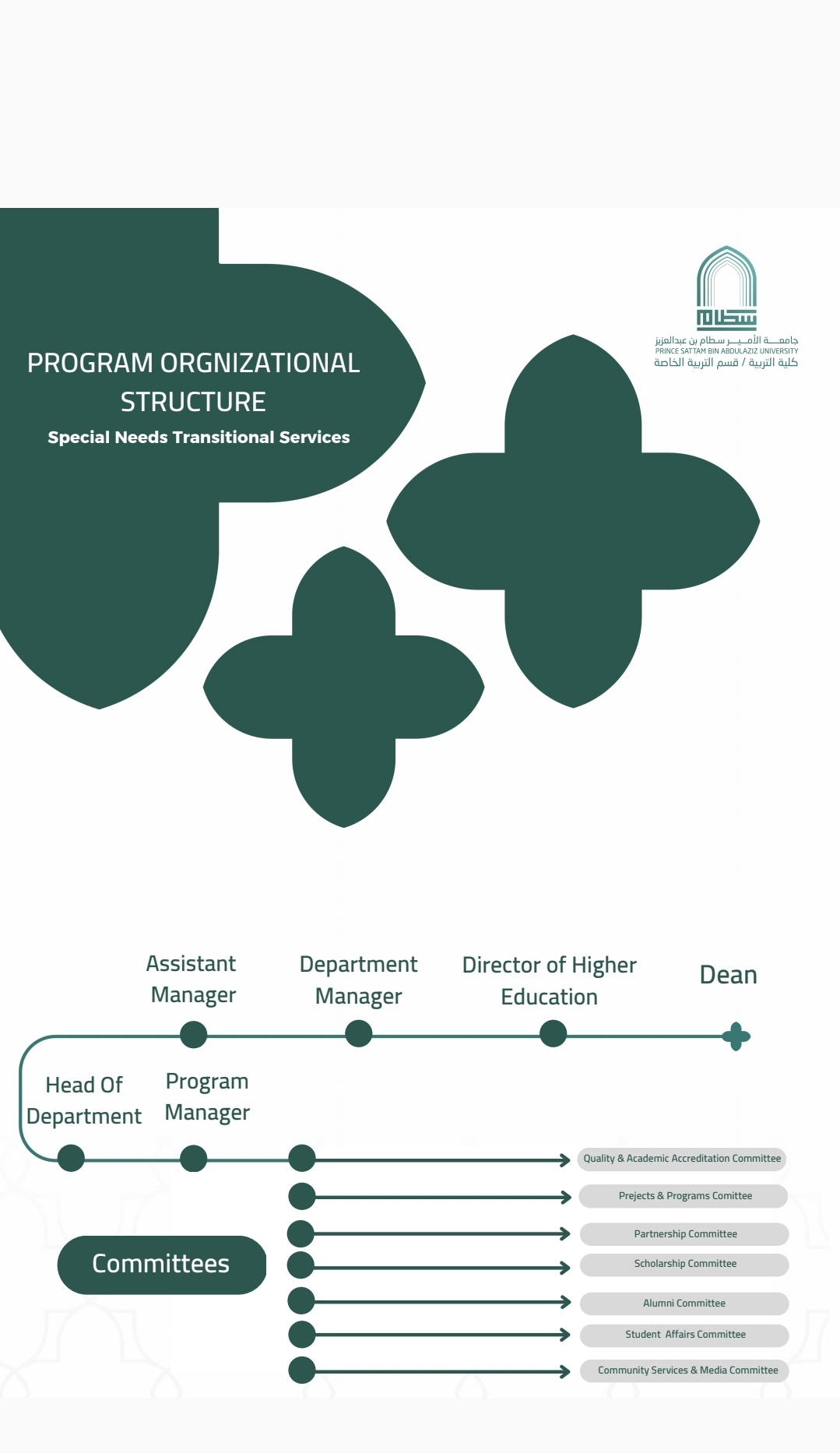
Program Learning Outcomes
Knowledge and understanding
K1 Define and interpret principles and theories related to transitional programs.
K2 Learn about evidence-based and evidence-based practices related to transitional services.
K3 Identify models and mechanisms for designing and implementing transitional programs.
K4 Knowledge of the mechanisms of preparing and applying scientific research in the field of transitional services.
Skills
S1 Applying scientific research methods and tools in the field of transitional services.
S2 Analyzing concepts, applications, and trends in providing transitional services.
S3 Evaluation of the effectiveness and efficiency of transitional services programs provided to people with disabilities.
S4 Design transition programs that take into account best practices based on evidence and research.
Values
V1 Commitment to the values of self-learning in acquiring knowledge and developing specialized skills.
V2 Commitment to the values and skills of effective communication and teamwork.
V3 Commitment to professional and research principles and ethics when working with people with disabilities.
| Name | Scientific Rank (Position) | Specialization | PhD degree Award University- country | Award Year | |
|---|---|---|---|---|---|
| 1 | Prof. Galeb Hamad Alnahdi | Professor | Intellectual Disability | Ohio University-America | 2012 |
| 2 | Dr. Mubarak Saad Aldosari | Associate Professor | Intellectual Disability | Ball State University-America | 2013 |
| 3 | Dr. Hussain Ali Almalky | Associate Professor | Intellectual Disability | University of Wisconsin-Madison-America | 2015 |
| 4 | Dr. Khalid Nasser Alasim | Associate Professor | Deaf Education | The Ohio State University-America | 2017 |
| 5 | Dr. Faisl Mohammad Alqraini | Associate Professor | Deaf Education | The Ohio State University-America | 2017 |
| 6 | Dr. Saeed Saad Alqahtani | Associate Professor | Learning Disabilities | University of Iowa-America | 2016 |
| 7 | Dr. Abdullah Abdulmohsen Alwahbi | Associate Professor | Autism Spectrum Disorder | University of Iowa-America | 2017 |
| 8 | Dr. Afrah Salem Bagazi | Associate Professor | Learning Disabilities | University of York-Britain | 2017 |
| 9 | Dr. Ali Nasser Alasmari | Assistant Professor | Deaf Education | The Ohio State University-America | 2017 |
| 10 | Dr. Abdulhadi Abdullah Alamri | Assistant Professor | Deaf Education | Lamar University-America | 2017 |
| 11 | Dr. Abdalmajeed Hamad Alrabiah | Assistant Professor | Special Education | University of Wisconsin-Madison-America | 2020 |
| 12 | 12 Dr. Rashed Binfehaid Alqahtani | Assistant Professor | Learning Disabilities | The University of North Carolina-America | 2020 |
| 13 | Dr. Salman Musa Almughyiri | Assistant Professor | Autism Spectrum Disorder | University of South Florida-America | 2021 |
| 14 | Dr. Doha Saif Alqahtani | Assistant Professor | Learning Disabilities | King Saud University-Saudi Arabia | 2022 |
Specifications for Master of Special Education courses
Prerequisite | Credits | Course Title | Course Code | |
| 4 | Introduction to Methods of Educational Researchh | SPED 640 | |
This course provides graduate students with the fundamental knowledge and skills necessary to conduct quality research in education and related social science fields. Upon successful completion of this course, students will be able to understand types of educational research, different research designs, and data analysis and collection techniques. In addition, students will be encouraged to design studies that address important current educational issues, gather and analyze data to shed light on these issues, and derive conclusions based on their analyses.
Course Objectives:
| Course Description | |||
Prerequisite | Credits | Course Title | Course Code | |
| 4 | Introduction to Transition | SPED 601 | |
This course will provide graduate students with an in-depth understanding of concepts related to positive transition planning for youths with disabilities. Upon successful completion of this course, students will understand the foundational concepts, historical context, and legal foundations of transition, as well as the transition planning process. Students will learn about the transition domains—employment, continued learning, and community integration—and the institutions and agencies that support students in working to achieve their postsecondary goals in each area. Students will learn about the role of the transition specialist and the rights and responsibilities of the youth and his or her family in transition planning. In addition, students will learn the issues, challenges, and strategies involved in helping youths with disabilities transition to work and participate to the fullest degree in society.
Course Objectives:
| Course Description | |||
Prerequisite | Credits | Course Title | Course Code | |
| 5 | Planning and Assessment in Transition | SPED 602 | |
This course provides graduate students with the knowledge and skills needed to assess and plan transition programs for youth with disabilities. Upon successful completion of this course, students will be able to identify a range of formal and informal instruments and tactics to plan and implement an assessment based on the needs of individual youth. In addition, participants will accurately interpret assessment results to develop appropriate individualized postsecondary goals that reflect students’ skills, interests, personal attributes, and accomplishments. Finally, participants will not only develop strategies to report results to students, family, and other team members but also work collaboratively to plan for students’ skill development and identify supports and services.
Course Objectives:
| Course Description | |||
Prerequisite | Credits | Course Title | Course Code | |
| 4 | Applied Educational Statistics | PSY 633 | |
This course teaches graduate students introductory concepts in statistics as they apply to the educational research sciences. Upon successful completion of this course, students will have the fundamental knowledge and skills to understand and conduct statistical research in social and behavioral sciences. Students will learn about and be exposed to different types of tests, including hypothesis tests and descriptive and inferential statistics, and develop the ability to select the appropriate statistical procedures.
Course Objectives:
| Course Description | |||
Prerequisite | Credits | Course Title | Course Code |
| ||
SPED 601, SPED 602 | 4 | Researches in transition | SPED 620 |
| ||
| This course aims to develop students’ interests in studies and scientific research in the area of postsecondary transition for students with disabilities. Emphasis will be placed on the studies (i.e., scientific articles published in scientific journals and theses) that deal with various issues related to contemporary trends in transition services. The course focuses on the methods of scientific research in these studies and trains students to analyze and criticize academic work using their research and statistical skills. It also gives students the opportunity to suggest solutions for appropriate methodology if they notice any problems. The course also emphasizes the importance of the latest documentation methods, such as APA style, in scientific research.
Course Objectives:
| Course Description | ||||
Prerequisite | Credits | Course Title | Course Code | |
| 4 | Single Subject Design | SPED 621 | |
This course provides graduate students with the knowledge and skills necessary for conducting single subject research design. Upon successful completion of this course, students will be able to understand types of single subject research design, and data analysis and collection techniques. In addition, students will be encouraged to design studies that use single subject research design, define behaviors for measurement, describe threats to internal and external validity, construct databases sheets, and evaluate these data using visual inspection procedures, descriptive statistics, and inferential statistics. Course Objectives:
References: Kazdin, A. E. (2011) Single case experimental designs: Strategies for studying behavior change (2nd ed.). Boston, MA: Allyn & Bacon Kratochwill, T. R. (Ed.). (2013). Single subject research: Strategies for evaluating change. Academic Press.
| Course Description | |||
Prerequisite | Credits | Course Title | Course Code | |||
SPED 601, SPED 602 | 4 | Career Development and Employment Models for Individuals with Disabilities | SPED 622 | |||
| The purpose of this course is to provide graduate students with an overview of career development and employment models for youth with disabilities. This course teaches students how to design and implement effective methods to help persons with disabilities obtain and maintain employment. Course content includes marketing and job placement skills, job seeking, training, job adaptation, supported and transitional employment, employer assistance and training, and follow-along services. To satisfy requirements of the practicum, transition teachers will work in a supported or competitive employment setting. Tasks will include performing assessments, providing job coaching for individuals with disabilities, developing natural supports among coworkers and employers, or promoting integrated employment. Course Objectives:
Determine elements in job development (transition planning, vocational rehabilitation, and practical work experience) | Course Description |
| |||
Prerequisite | Credits | Course Title | Course Code | |
SPED 601, SPED 602 | 3 | Practicum in transition
| SPED 630 | |
This course provides graduate students with the skills needed to conceptualize, design, implement, and evaluate a comprehensive career development program in almost any setting in which they may work. Upon successful completion of this course, students will be able to survey an environment, coordinate with business owners, assess individual and organizational needs, apply theory to program design, develop or utilize career interventions, and evaluate program outcomes. Course Objectives:
References Sampson, J. P., Jr. (2008). Designing and implementing career programs: A handbook for effective practice. Broken Arrow, OK: National Career Development Association.
Epstein, S. A., & Lenz, J. G. (2008). Developing and managing career resources. Broken Arrow, OK: National Career Development Association.
Makela, J. P., & Rooney, G. (2012). Learning outcomes assessment step-by-step: Enhancing evidence base practice in career services. Broken Arrow, OK: National Career Development Association. | Course Description | |||
Prerequisite | Credits | Course Title | Course Code | |
- | 6 | Thesis | SPED 630 | |
| Course Description | |||
 Study Plan